There is a noticeable change taking place in high-end interiors.
For years, luxury was often expressed through accumulation: more accessories, more artwork, more furniture, more decorative layers. Today, many of the most sophisticated residential spaces are moving in the opposite direction.
They contain fewer objects, but the objects they contain have greater presence.
This shift has made statement sculpture particularly relevant.
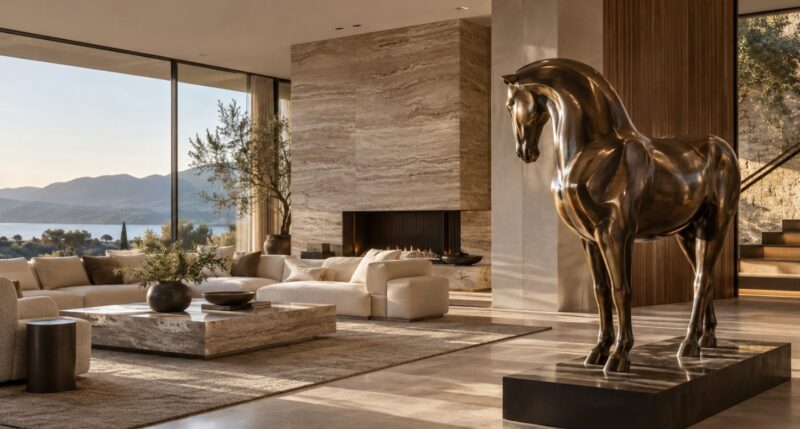
An oversized horse, an abstract human figure, a polished animal sculpture, or a contemporary reinterpretation of a classical form can do something that dozens of smaller accessories struggle to achieve: establish a clear identity for the room.
The result is not simply decoration. It is visual architecture.
Why statement pieces work?
Every successful interior has hierarchy.
When everything in a room demands attention, nothing feels particularly important. A strong focal point solves this problem by creating an immediate visual order.
Traditionally, that focal point might have been a fireplace, a dramatic chandelier, a painting, or a large window with an exceptional view.
Sculpture introduces another possibility.
Because it exists in three dimensions, it interacts with both the room and the person moving through it. Its silhouette changes depending on the viewing angle. Light moves across its surface. Shadows shift throughout the day. A polished piece may even reflect parts of the surrounding architecture.
This makes sculpture feel less like an accessory placed inside the room and more like part of the room itself.
Large spaces require appropriately scaled objects
One reason oversized art has become more relevant is architecture itself.
Contemporary luxury homes frequently include double-height living rooms, open floor plans, broad entrance halls, extensive glazing, wide staircases, and large areas of uninterrupted wall space.
These dimensions can overwhelm conventional décor.
A sculpture that would appear dramatic in a standard room may look surprisingly small in a six-meter-high entrance hall. Conversely, a properly scaled piece can help make a vast interior feel intentional rather than empty.
This principle applies beyond mansions and large villas. Even a relatively restrained interior can benefit from a substantial focal object when the surrounding design is kept clean.
The important question is not simply, “Is this sculpture large?”
It is, “Is this sculpture appropriately scaled for this space?”
One major piece can replace dozens of accessories
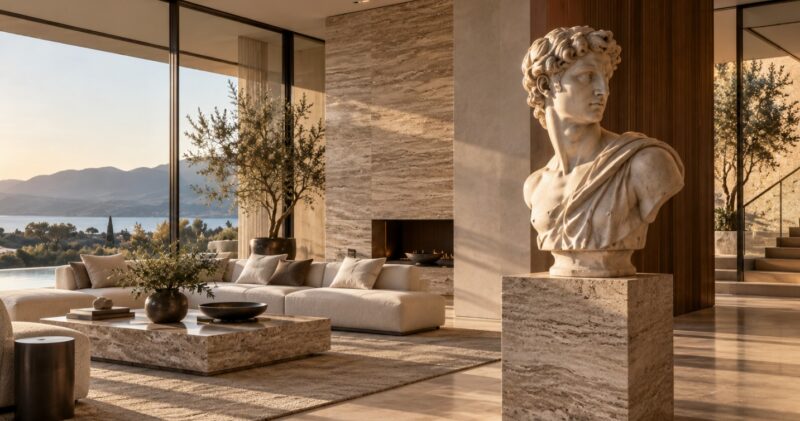
Minimalism does not necessarily mean living without objects. It means being more selective about them.
Instead of filling consoles, coffee tables, shelves, and corners with decorative accessories, designers can allow one major artwork to carry much of the visual responsibility.
A dramatic floor sculpture in a living room, for example, can remove the need for multiple competing decorative pieces.
The room may actually feel richer as a result.
This is the difference between visual quantity and visual impact.
For homeowners considering this approach, specialist collections such as Overscale Art’s sculpture selection demonstrate how animal forms, figurative art, abstract pieces, and architectural sculptures can be used at dimensions intended to command a space rather than disappear within it.
The objective should not be to make a room feel crowded with expensive things. It should be to make every object feel deliberate.
Animal sculpture brings character without relying on trends
Animal forms have appeared in art for thousands of years, which gives them an interesting advantage in contemporary interiors: they can feel expressive without being tied to a particular decorating trend.
A horse can communicate elegance and movement.
A panther or leopard can introduce tension and energy.
An elephant creates an entirely different silhouette and sense of weight.
Dogs and other familiar animals can bring playfulness into otherwise serious spaces.
The way these forms are interpreted matters just as much as the subject itself. A highly realistic bronze horse creates a different atmosphere from an exaggerated fiberglass version or a polished geometric interpretation.
That versatility allows animal sculpture to work across surprisingly different interiors, from minimalist houses to eclectic apartments and dramatic commercial spaces.
Classical forms look surprisingly modern in contemporary rooms
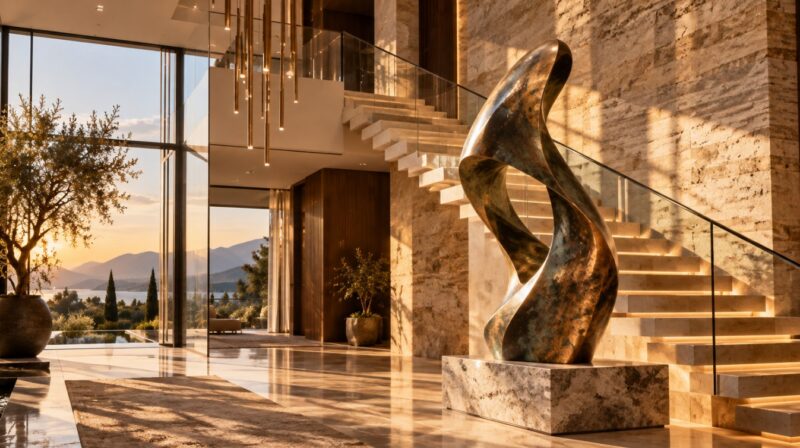
Another interesting design technique is contrast.
A classical human figure inside a traditionally decorated house feels expected. Put the same visual language inside a sharply contemporary interior and the result becomes much more interesting.
Against microcement walls, modern furniture, minimal architectural detailing, or expansive glass, a classical-inspired form can become almost abstract.
This is why Greek and Roman references continue to appear in contemporary interiors.
The appeal is not necessarily nostalgia. It is contrast between historical visual language and modern surroundings.
A similar approach can work with fragmented figures, busts, reinterpretations of classical anatomy, or sculptures finished in unexpected contemporary materials.
Finish can completely change the mood
When choosing a sculpture, homeowners often focus first on the subject.
Material and finish deserve equal attention.
A mirror-finish sculpture can bring movement into an interior because its surface constantly changes according to what surrounds it.
Matte finishes behave very differently. A stone-like white, gray, black, or neutral surface emphasizes silhouette and texture rather than reflection.
Metallic finishes can make a piece feel glamorous or industrial depending on the tone and form.
Textured surfaces tend to feel more tactile and artisanal.
Because large pieces occupy so much visual space, their finish becomes almost another architectural surface in the room.
It should therefore relate to flooring, wall treatments, metals, furniture, and lighting rather than being considered independently.
Where should a statement sculpture go?
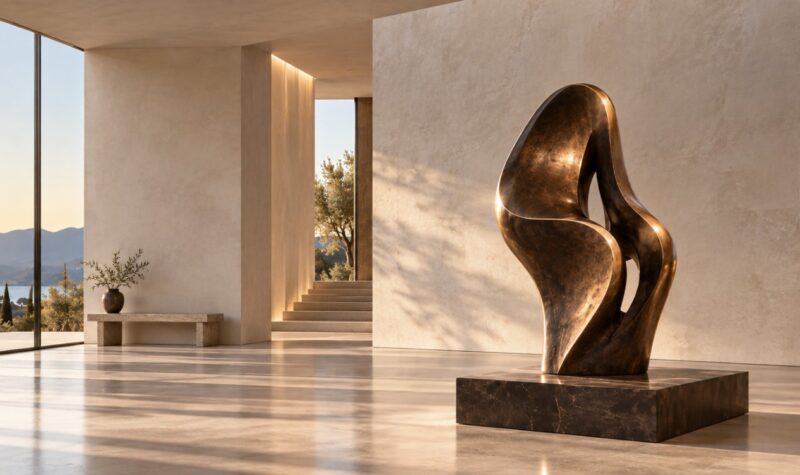
The most obvious location is not always the best one.
A sculpture can work beautifully in several parts of a home.
Entrance halls
The entrance provides an opportunity to establish the visual language of the house immediately. A sculpture can become the first major object guests see.
Living rooms
Positioning a piece close to a large window, beside a fireplace, or at the edge of a seating composition can create a focal point without interfering with circulation.
Staircases
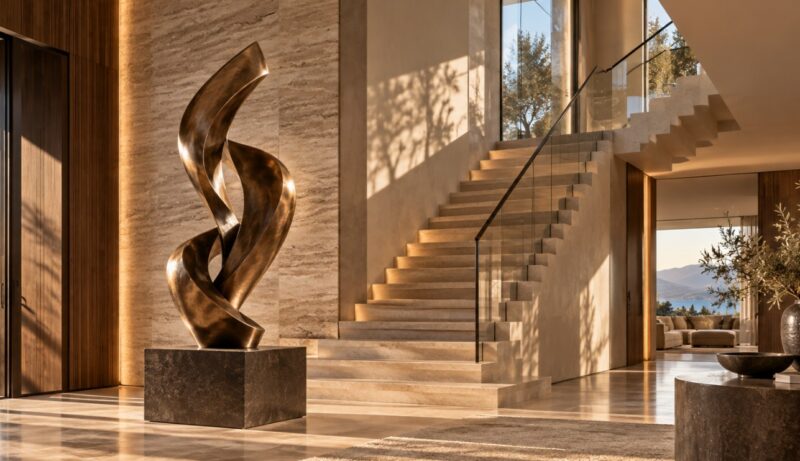
Open staircases frequently create tall unused volumes that are difficult to decorate with conventional furniture. Sculptural installations can take advantage of that vertical space.
Corridors
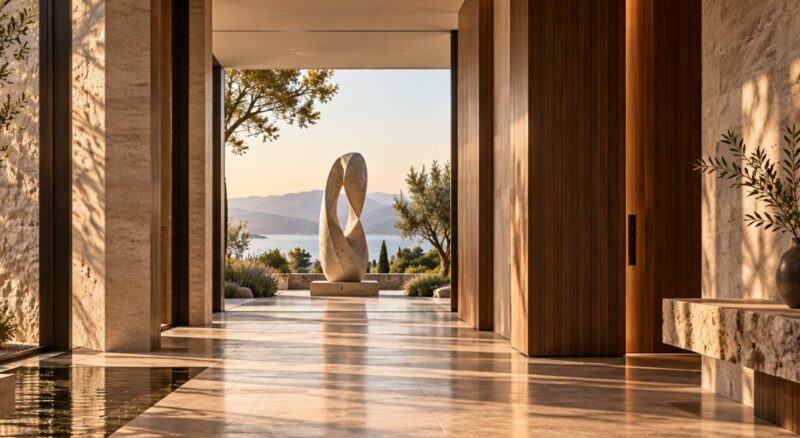
A long sightline ending with a dramatic object creates a sense of purpose and draws people through the architecture.
Gardens and terraces
Outdoor sculpture can connect landscaping and architecture while creating a focal point visible from inside the house.
Home offices
A single unusual object can introduce personality into a restrained workspace without adding unnecessary visual clutter.
Lighting should be part of the decision
Good lighting can transform the way sculpture is perceived.
Directional lighting emphasizes texture and throws shadows across nearby surfaces. Soft ambient light creates a quieter effect. Natural light may produce an entirely different appearance throughout the day.
Reflective pieces require particularly careful positioning because windows, lamps, furniture, and even movement within the room may appear in their surfaces.
For this reason, it is useful to think about artwork and lighting simultaneously rather than selecting the sculpture after the electrical plan has already been finalized.
Give important pieces room to breathe
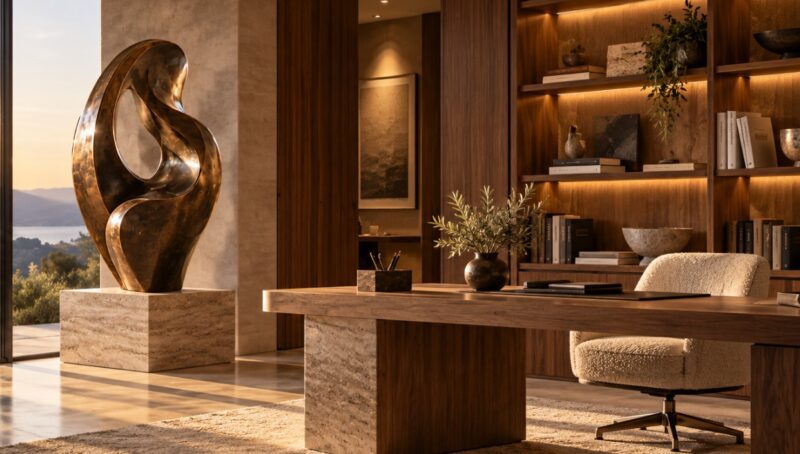
One of the easiest mistakes to make is placing too much around a statement sculpture.
If the piece is intended to command attention, it should not be surrounded by competing artwork, plants, decorative objects, furniture, and patterned surfaces.
Negative space increases impact.
This is particularly true for sculptural forms with distinctive silhouettes. Leaving clear space around the perimeter makes the shape easier to understand and gives the object greater visual importance.
Luxury interiors often feel luxurious precisely because they are comfortable leaving space unused.
The goal is not size for the sake of size
Oversized design can easily become gimmicky when scale is the only idea.
The strongest interiors use large sculpture because it contributes something meaningful: proportion, contrast, movement, personality, texture, or narrative.
That distinction matters.
A large object chosen purely because it is surprising may become tiring. A strong sculpture that relates to the architecture can continue to feel appropriate even as furniture, textiles, and smaller decorative elements change around it.
This makes statement art potentially more enduring than many short-lived interior trends.
A different definition of luxury
Perhaps the most interesting aspect of statement sculpture is what it reveals about contemporary luxury.
Luxury is becoming less about how many things a space contains and more about how confidently those things are chosen.
A room with twenty decorative objects can still feel generic.
A room with excellent proportions, thoughtful materials, strong lighting, and one extraordinary sculpture can be almost impossible to forget.
That is the power of the statement interior.
It does not need to shout from every corner.
Sometimes one object is enough.